Try to remember the last time you saw the Milky Way. Not a photo of it. The actual thing, spilt across the whole sky. For a lot of people, the honest answer is “never,” or “once, years ago, on a trip I keep meaning to repeat.”
For most of human history, the dark was just there. You lived under it every night, whether you wanted to or not. Then we lit everything up, and somewhere in the process the night sky slipped off the list of things many people get to see. Now it’s coming back around as a reason to pack a bag. The travel world even has a name for it, albeit a slightly awkward one: noctourism.
A clumsy word, but, no doubt, an interesting idea. It covers everything that happens once the sun clocks off: stargazing, night safaris, after-dark city walking tours, glowing plankton on a dark beach, and, top of most people’s lists, the northern lights. National Geographic Traveller ran a long feature on it in 2025 and made the case plainly: When almost every corner of the map has been photographed to death in daylight, the night offers somewhere left to look.
- Search any US state to see how far you'd have to drive to reach certified darkness with the Dark-Sky Index
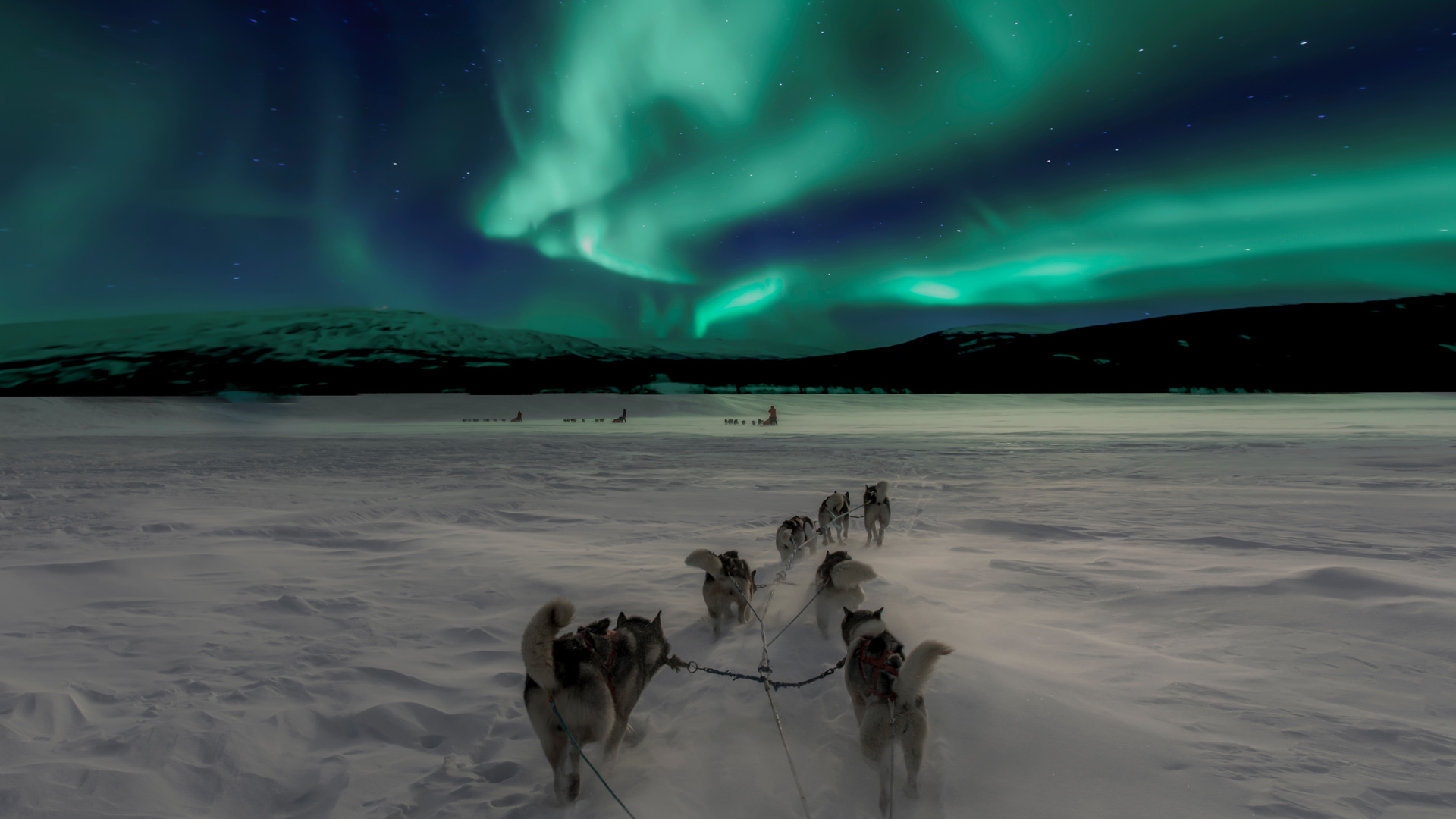
A Booking.com survey across 33 countries found nearly two-thirds (62%) of travellers were weighing up trips with built-in night-time experiences. Luxury operator Wayfairer Travel reported its nocturnal excursions up by a quarter in 2024. Over at Flash Pack, demand among millennial travellers jumped 40%, with the company’s co-founder pointing to a growing appetite for experiences that don’t revolve around going out to a bar.
But the night sky is disappearing for most of us. Robert Massey of the Royal Astronomical Society puts the growth of light pollution at roughly 10% a year, and reckons the Milky Way is already invisible to about a third of the world's population.
The definitive count comes from the New World Atlas of Artificial Night Sky Brightness, published in Science Advances in 2016 by Fabio Falchi and an international team. They combined satellite data, ground measurements and a model of how light scatters through the air to work out who, exactly, has lost the stars.
The answer was bleak.
More than 80% of the world, and more than 99% of people in the United States and Europe, now live under light-polluted skies. For North Americans specifically, it's nearly 4 in 5. Almost half of the United States no longer experiences a truly dark night.
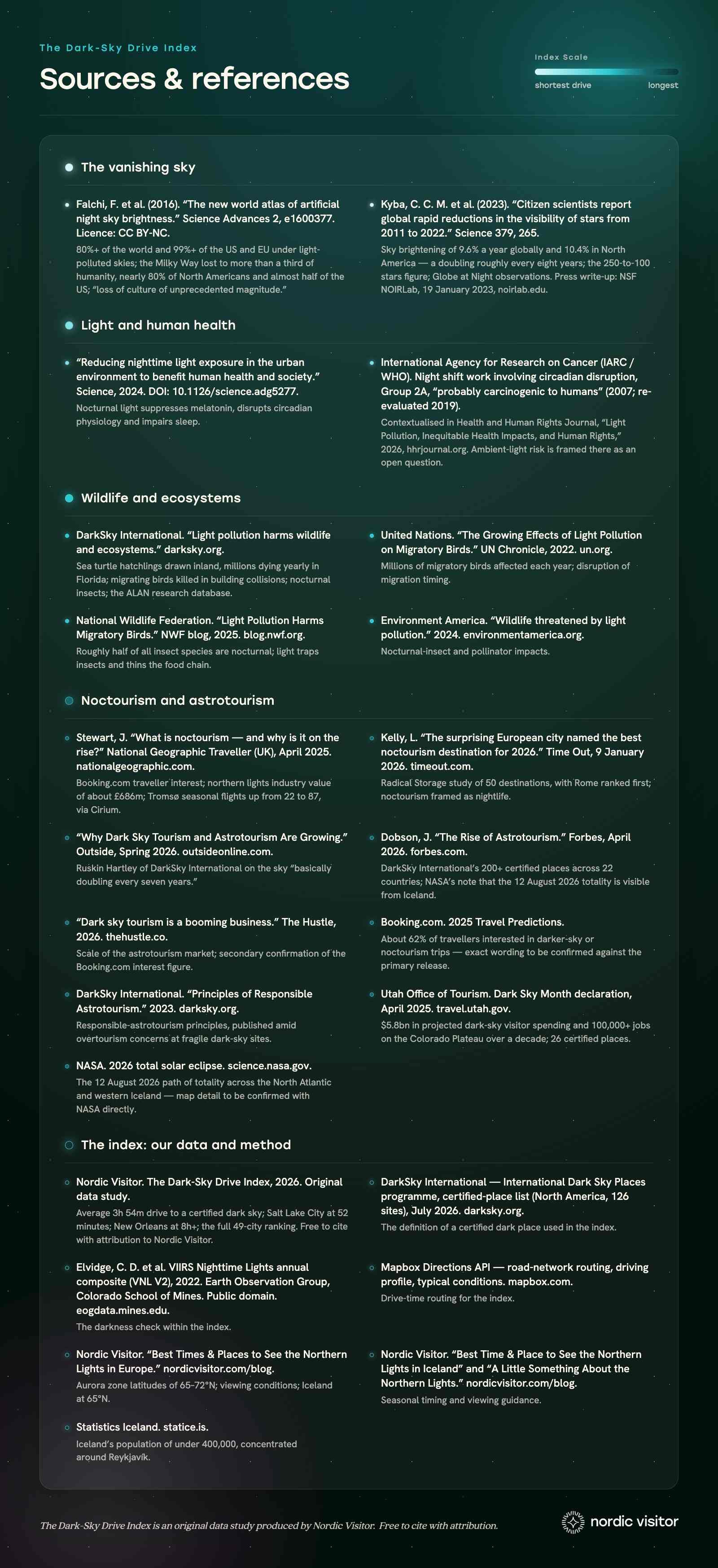
In 2023, a second study, led by Christopher Kyba and also published in Science Magazine, showed the sky isn't just bright; it's brightening fast. Kyba's team leaned on more than 50,000 star counts sent in by people from their own backyards through the Globe at Night project. While satellites clocked the glow creeping up around 2% a year, the human eye told a harsher story: nights are brightening by 9.6% a year worldwide, and by a steeper 10.4% a year across North America. That works out to the sky roughly doubling in brightness every 8 years.
Kyba has explained this in simpler terms: A child born somewhere where 250 stars are visible
would, on that trajectory, see only about 100 of them by the time they turned 18.
Which is why a genuinely dark place has become a destination in its own right. The non-profit DarkSky International now certifies more than 160,000 square miles of protected night worldwide, as Dark Sky Parks, Reserves and Sanctuaries. People are travelling specifically to stand under that certified dark, the way they'd travel to a beach or a mountain.
It's tempting to file all this under lost scenery, a shame for stargazers and no one else. But let’s start with wildlife.
Around half of all insect species are nocturnal, and artificial light pulls them in and holds them there until they tire out or get eaten, which thins the base of the food chain that birds and bats depend on.
On Florida's beaches, lights behind dunes draw turtle hatchlings inland instead of out to sea, and millions die that way every year. Migrating songbirds steer by the stars and drift toward lit towers, where collisions kill millions more. It's why so many cities now switch their buildings dark during migration season. DarkSky International maintains a public database of research that includes hundreds of studies.
When it comes to the effects on people, the science is younger and worth stating carefully. Light at night suppresses melatonin and knocks the body's internal clock out of step. The World Health Organisation's cancer agency has twice judged shift work involving that kind of disruption a probable carcinogen. Whether the glow most of us now sleep under carries a milder version of the same risk is what researchers are working to pin down. Circadian disruption has also been linked to poorer sleep and mood, though the evidence tied specifically to outdoor light is still building.
The Milky Way was visible overhead for every human generation until roughly this one. Falchi's team has described this as a loss of culture of unprecedented magnitude: a luminous fog that has cut most of the planet off from the sight of its own galaxy.
Which brings us to the selling, because as the real thing has grown scarce, the appetite for it has climbed, and a whole category of travel has emerged around darkness.
The northern lights alone were worth an estimated £686 million by 2023, and flights into Tromsø, northern Norway's aurora hub, jumped from 22 to 87 in a single season as airlines chased the traffic, according to the analysts at Cirium.
DarkSky International has now certified more than 200 places across 22 countries, and Utah alone reckons dark-sky visitors could spend roughly $5.8 billion and support over 100,000 jobs on its Colorado Plateau across a decade.
But the rush to reach dark places can bring the light along with it. DarkSky grew worried enough about crowds and new development at fragile sites to publish a set of responsible-astrotourism principles in 2023.
The Dark-Sky Drive Index
Nearly 80% of North Americans can't see the Milky Way from home. Which is a striking figure and a fairly useless one, because it doesn't tell you how far you'd personally have to drive to escape it.
So we worked that out.
For the largest city in 48 contiguous states plus Washington, DC, we calculated the real driving distance to the nearest independently certified dark place: a DarkSky International Park, Reserve or Sanctuary. Then we routed the drive by road.
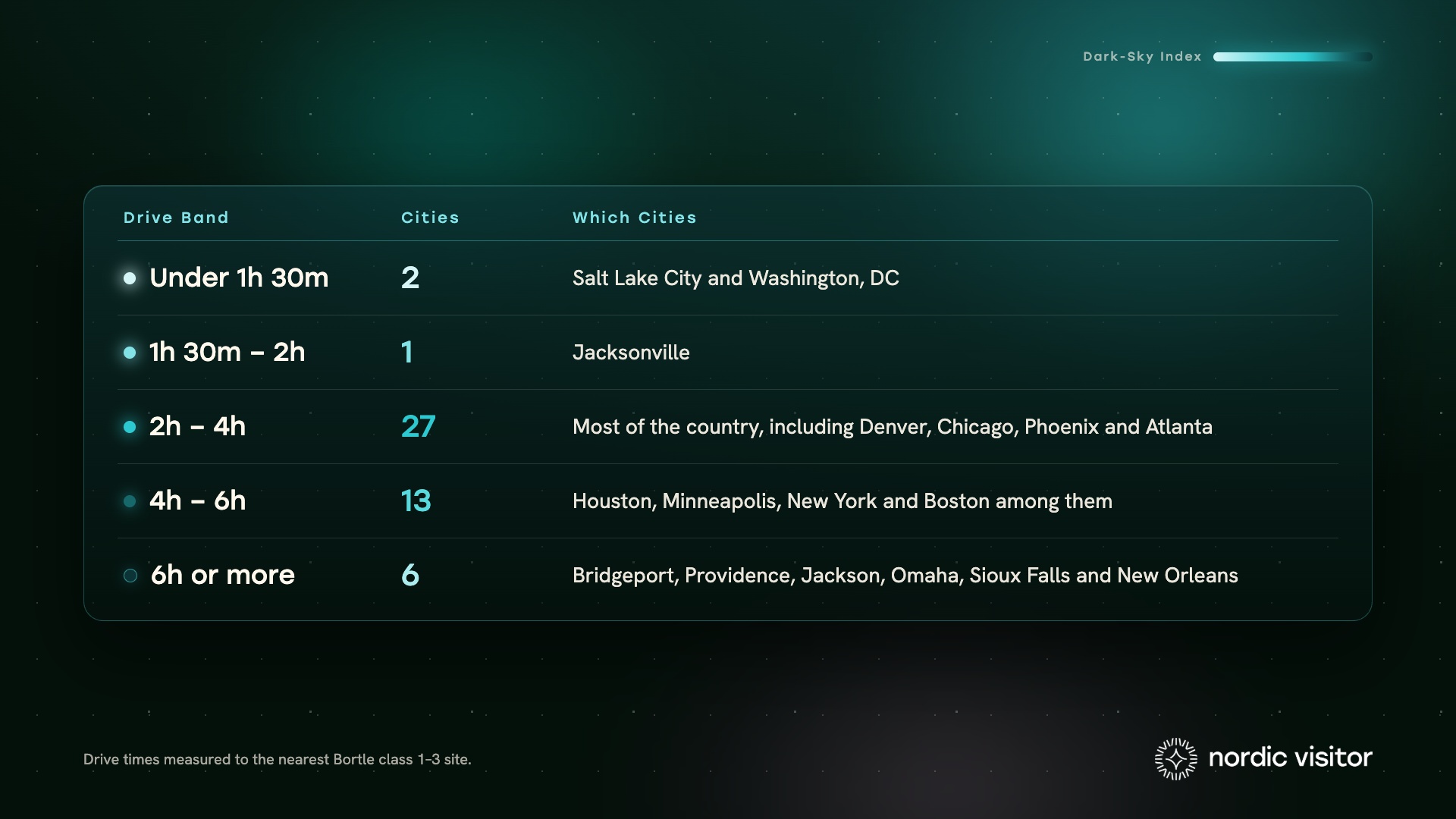
The average drive to a certified dark sky is 3 hours 54 minutes each way, call it 220 miles. The median city faces 3 hours 37 minutes. Because those are one-way numbers, the typical trip is a 7-hour-plus round trip before you've spent a single minute actually looking up. For most of urban America, a properly dark sky is simply out of reach.
Within our drive band, Salt Lake City lands as the clear leader: East Canyon State Park is a mere 52 minutes away from the metropolitan area. At the far end, New Orleans is the most light-locked city in the country. Its nearest certified dark place is Stephen C. Foster State Park, over the line in Georgia, a full 8 hours and 9 minutes away.
Where the dark still lives
The dark hasn't gone everywhere. It survives in the certified places the movement has fought to protect, like Cherry Springs in Pennsylvania and Big Bend in Texas, and in towns like Flagstaff, Arizona, the first place in the world to write dark skies into its lighting laws, back in 2001.
And it survives, almost by accident, in Iceland, Norway and Sweden. The contrast with the American numbers is sharp. Iceland has fewer than 400,000 people, nearly all of them around Reykjavík, so past the city’s glow there’s very little left to light the sky. Þingvellir National Park, one of the more popular spots to watch for the aurora, is located about 45 minutes from the capital.
Iceland also sits at around 65°N, inside the aurora zone between roughly 65 and 72°N, where the northern lights appear most often.
Our travel experts in Iceland have watched thousands of these nights, and they're refreshingly plain about how it works. They’ll tell you 3 things have to line up to see the northern lights: clear skies, darkness, and solar activity. Then they add a fourth, only half joking. You also need a lot of hope.
We take people to see the night for a living, so we won't pretend to be neutral about it. But the reason the dark is worth selling is the same reason it's worth saving. It’s older than every border and every language; and for now, in a few lucky corners of the world, it’s still there. The only real trick is getting to it before the glow does.