What does it actually mean to live like the French? Not the clichés – the beret, the baguette tucked under an arm – but the real stuff.
Shorter working hours. The Saturday farmers’ market that half the town turns up to. The artisan cheese shop that has been there for 40 years. Walkable neighbourhoods that encourage flânerie: the art of lingering, browsing, and taking the long way home.
To celebrate the launch of our France tours, we tried to answer that question with the data. We built America’s Most French State Index: 11 criteria, 50 states, all scored on publicly available data from the US Census Bureau, the Bureau of Labor Statistics, the USDA, and other authoritative sources.
The measures looked at French heritage and language, work-life balance, local food culture, wine production, cycling, walkability and bookshops. Each criterion was chosen because it reflects a quality France is known for and because, wonderfully, someone has counted it for every single state.
We did not expect what we found.
Every state has a story
.jpg)
The heat map shows all 50 states shaded by their French lifestyle score – deep green for the most French, fading to pale for those with a lighter French influence.
But look closer. Every state has a badge too, marking its single most French quality. Wyoming is strongest for bookshops. Hawaii stands out for artisan bakeries. California leads in wine production. Turns out France is everywhere – it just goes by different names.
Together, the shading and badges show that there is no single way for a state to feel French. Some rank highly overall, while others shine in one unexpectedly French corner of the data.
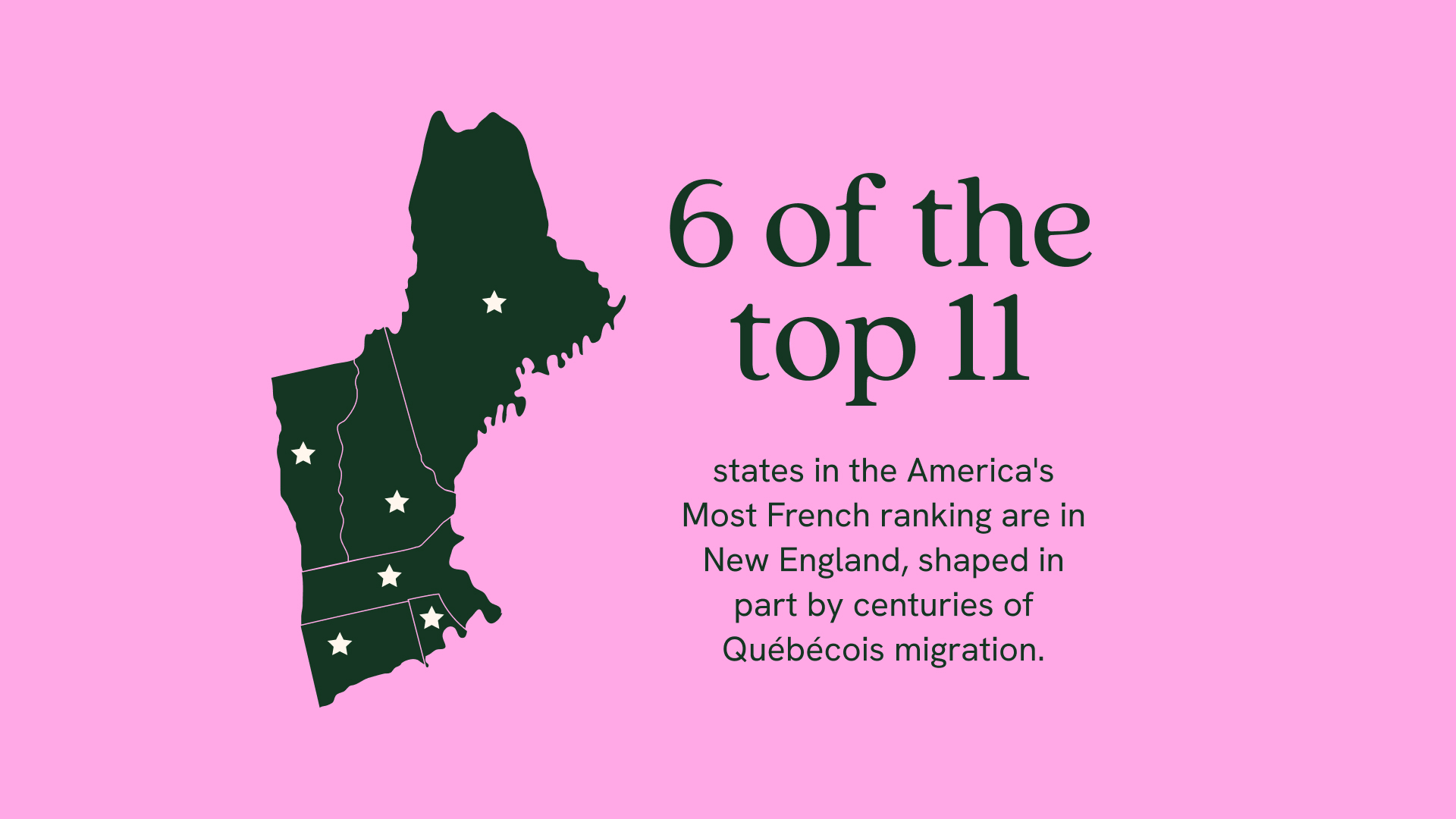
The most French region in America is New England
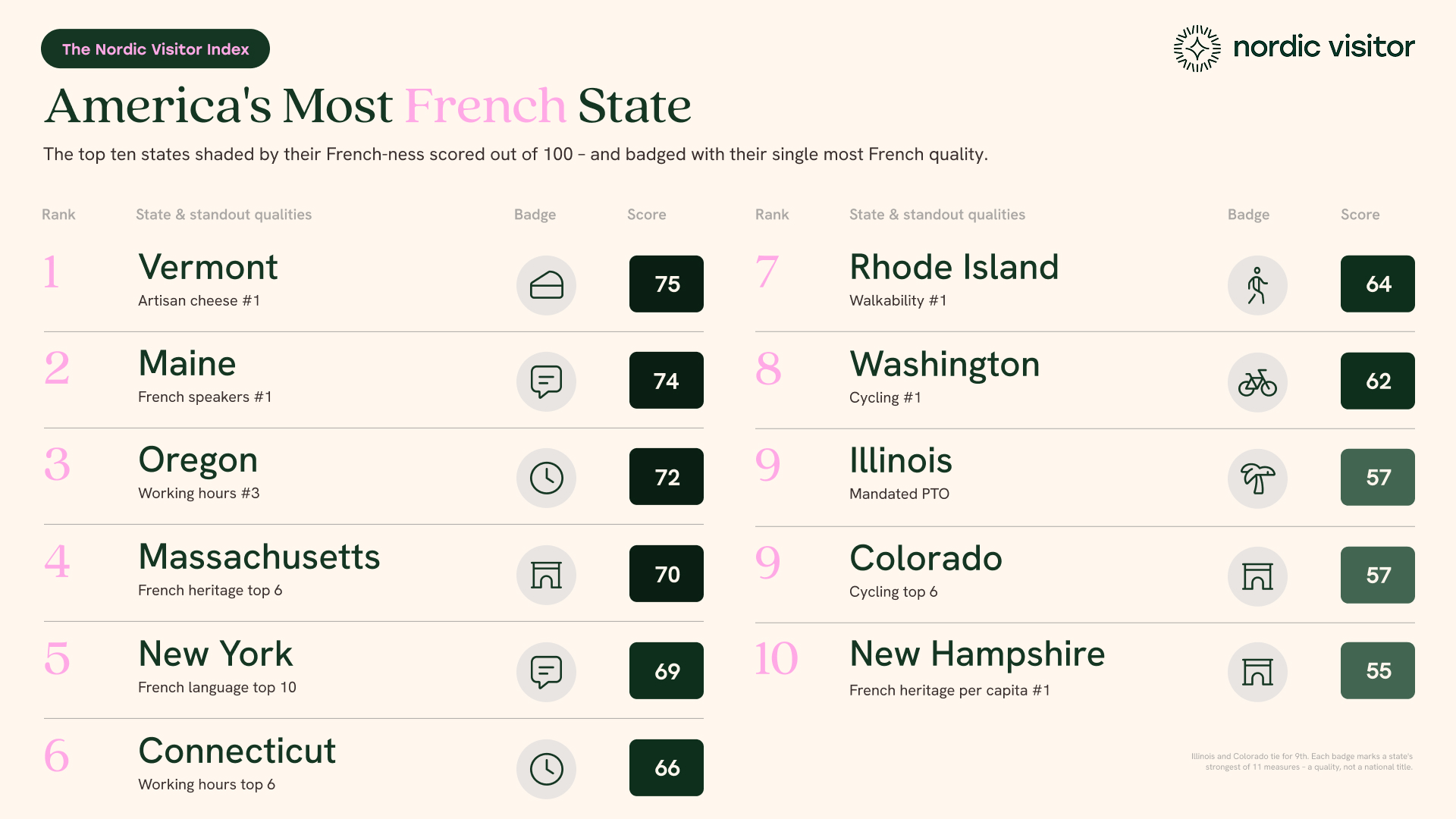
Look at the top 11 states, and a pattern emerges: Vermont, Maine, Oregon, Massachusetts, New York, Connecticut, Rhode Island and New Hampshire. 6 of the top 11 are in New England.
A big part of the explanation is the French-Canadian migration. From the mid-19th century onwards, French-Canadians – many of them descended directly from the original French settlers of New France – moved south into New England’s mill towns and farming communities in significant numbers.
They brought their language, their food traditions, their Catholic faith and customs. In Maine, French is still spoken at home by more residents than any other non-English language. In New Hampshire, nearly 1 in 5 residents reports French or French-Canadian ancestry.
New England is, in a very real sense, the most French part of America that most Americans have never thought of as French.
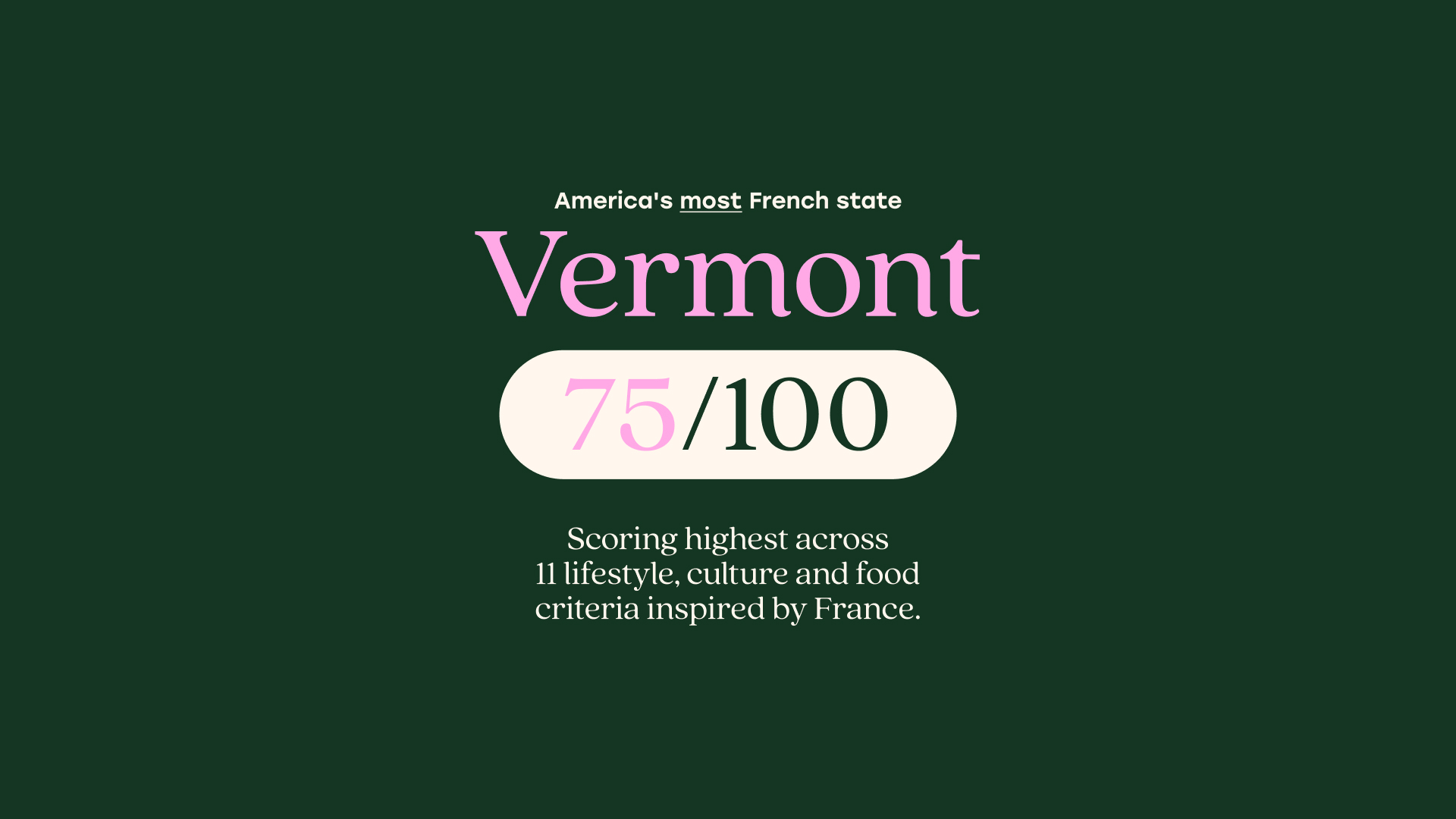
Vermont: America's most French state
What makes Vermont’s win interesting is how it gets there. It doesn’t top the ranking because it’s particularly French by name or heritage. New Hampshire and Maine both have higher concentrations of French and French-Canadian ancestry.
Vermont wins because, in many ways, it lives like France.
It ranks #1 in the country for artisan cheesemakers per capita and #1 for farmers’ markets per capita – two markers of the local, seasonal food culture France is famous for.
General de Gaulle, France’s wartime leader and longest-serving president, famously once asked, “How can you govern a country which has 246 varieties of cheese?” A question that says everything about how seriously France takes its cheese. Brie, Camembert, Roquefort (the list, like the varieties, goes on) – French cheese is one of the clearest symbols of French food culture.
Vermont, it turns out, takes cheese just as seriously. Its cheesemakers won 142 domestic and international awards in 2023 alone, including medals at the World Cheese Awards, the American Cheese Society competition and the International Cheese & Dairy Awards.
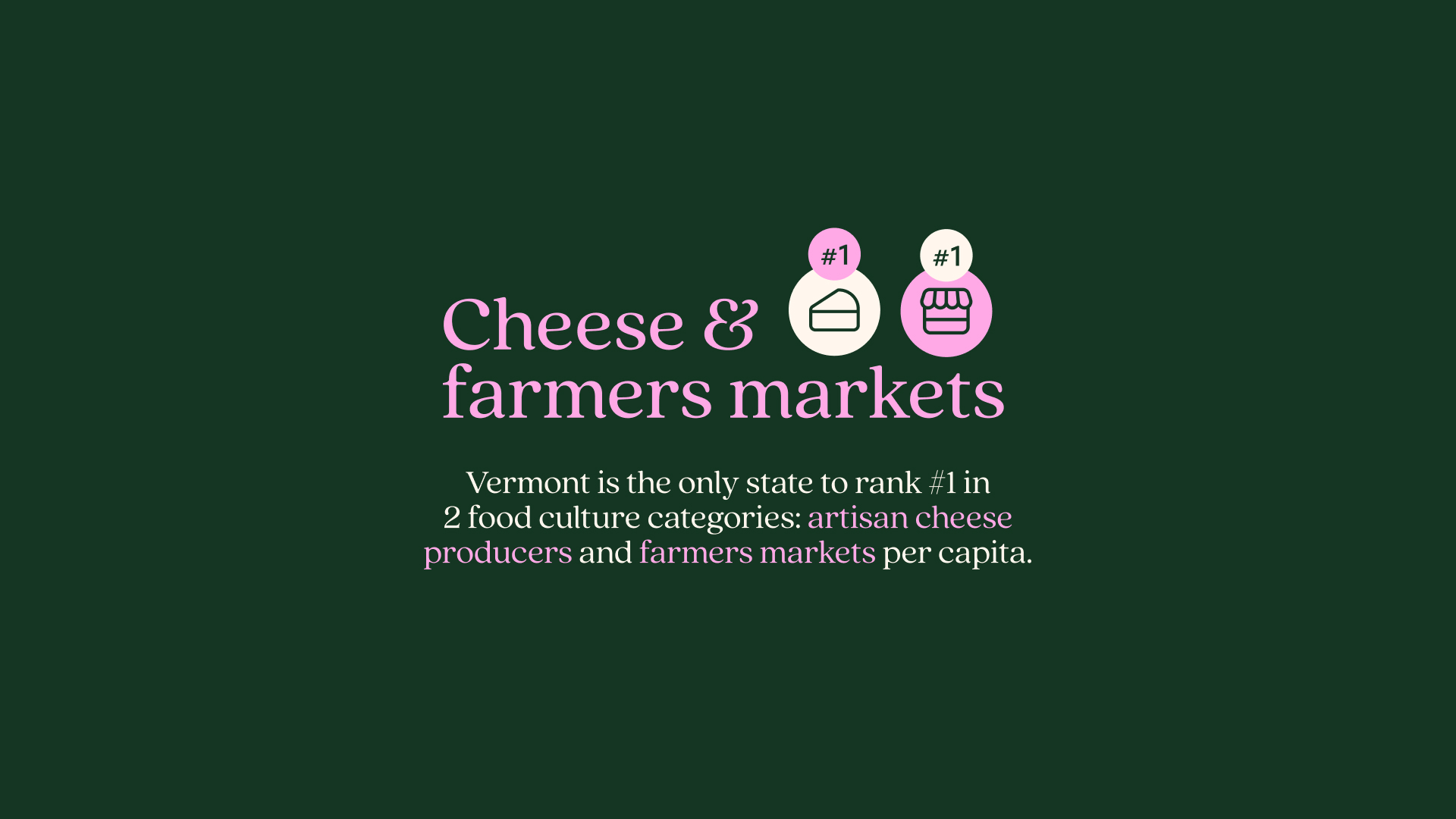
The French marché is equally iconic. From South of France markets piled high with sun-ripened produce to Parisian markets selling bread, flowers and seasonal ingredients, markets are where France’s local food culture comes to life.
Vermont also has the second shortest average working week of any US state, at 37.5 hours, echoing France’s own approach to work-life balance. The standard legal full-time workweek in France is 35 hours.
The French influence runs further still. France has more than 3,000 independent bookshops nationwide. The neighbourhood librairie is a cultural institution. Vermont, itself has more bookshops per person than all but one other state.
Taken together, these qualities point to the character of a small, largely rural, food-focused state that has, perhaps without meaning to, become distinctly French.
Vermont is French in its habits. Maine is French in its roots.
Maine: The most literally French state
Where Vermont wins on lifestyle, Maine wins on identity. It finishes second overall (74/100), and its story is a different kind of French entirely.
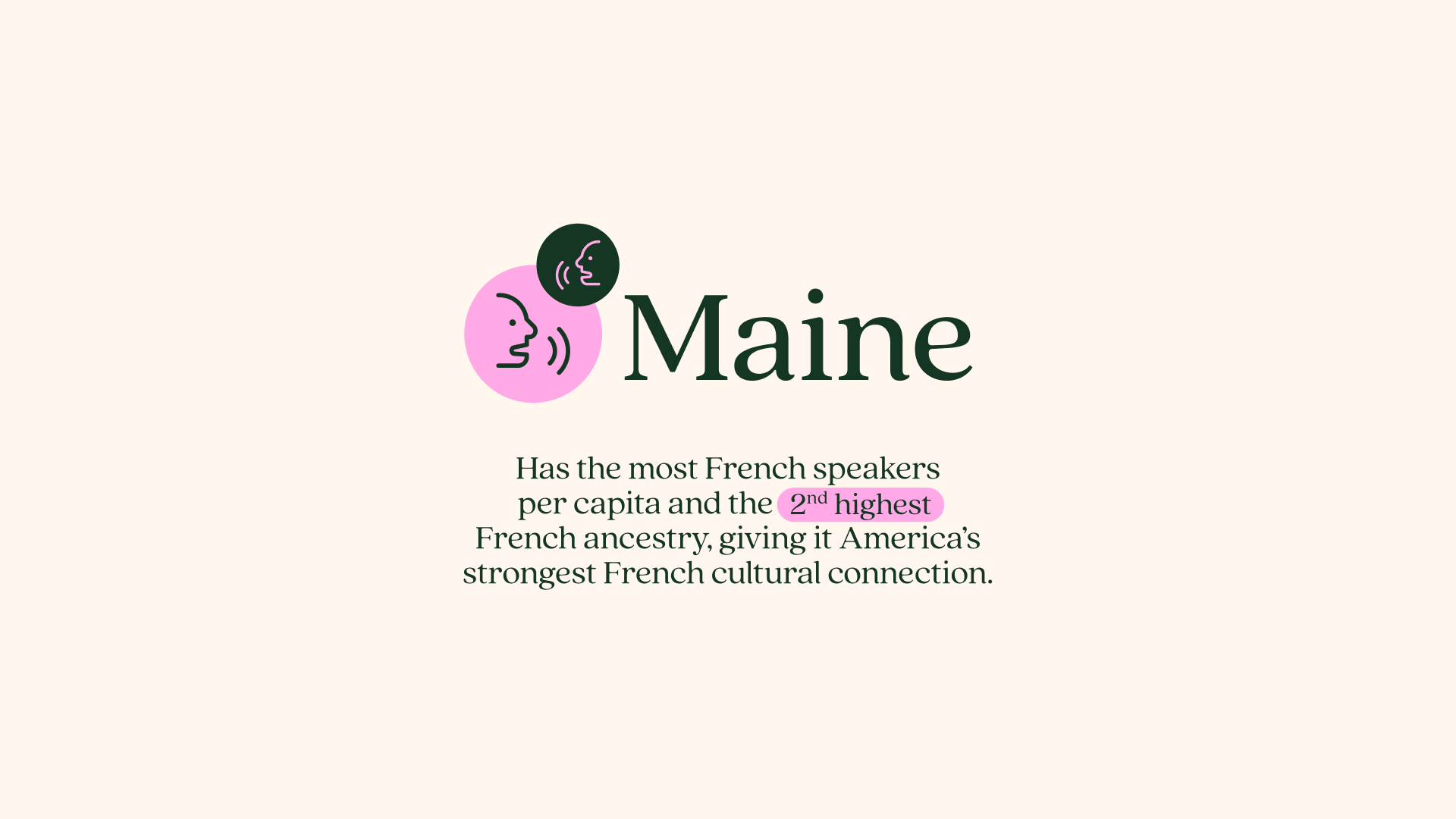
Maine ranks #1 in the country for French language speakers per capita, with 2.6% of residents speaking French at home. A figure that puts it ahead of every other state, including Louisiana, whose French-speaking roots run just as deep.
It also ranks #2 nationally for French heritage, with 18% of residents tracing their ancestry to France or French Canada.
There are towns in Maine where you might hear French spoken at the next table. Where French last names reflect generations of Franco-American heritage. And where many families trace their roots to French-speaking communities across the Canadian border.
Maine is also 1 of only 3 US states, alongside Illinois and Nevada, that legally mandates paid time off for workers. Every employee in France is entitled to 30 working days of paid leave for a full year of work, under French labour law.
Oregon: The surprise contender
Oregon arrives at #3 through a lifestyle alignment nobody planned.
It has no Québécois migration story, no deep French ancestry, no historic French colony. What it has is a way of life that maps closely onto French habits across multiple categories, and the data picked that up.
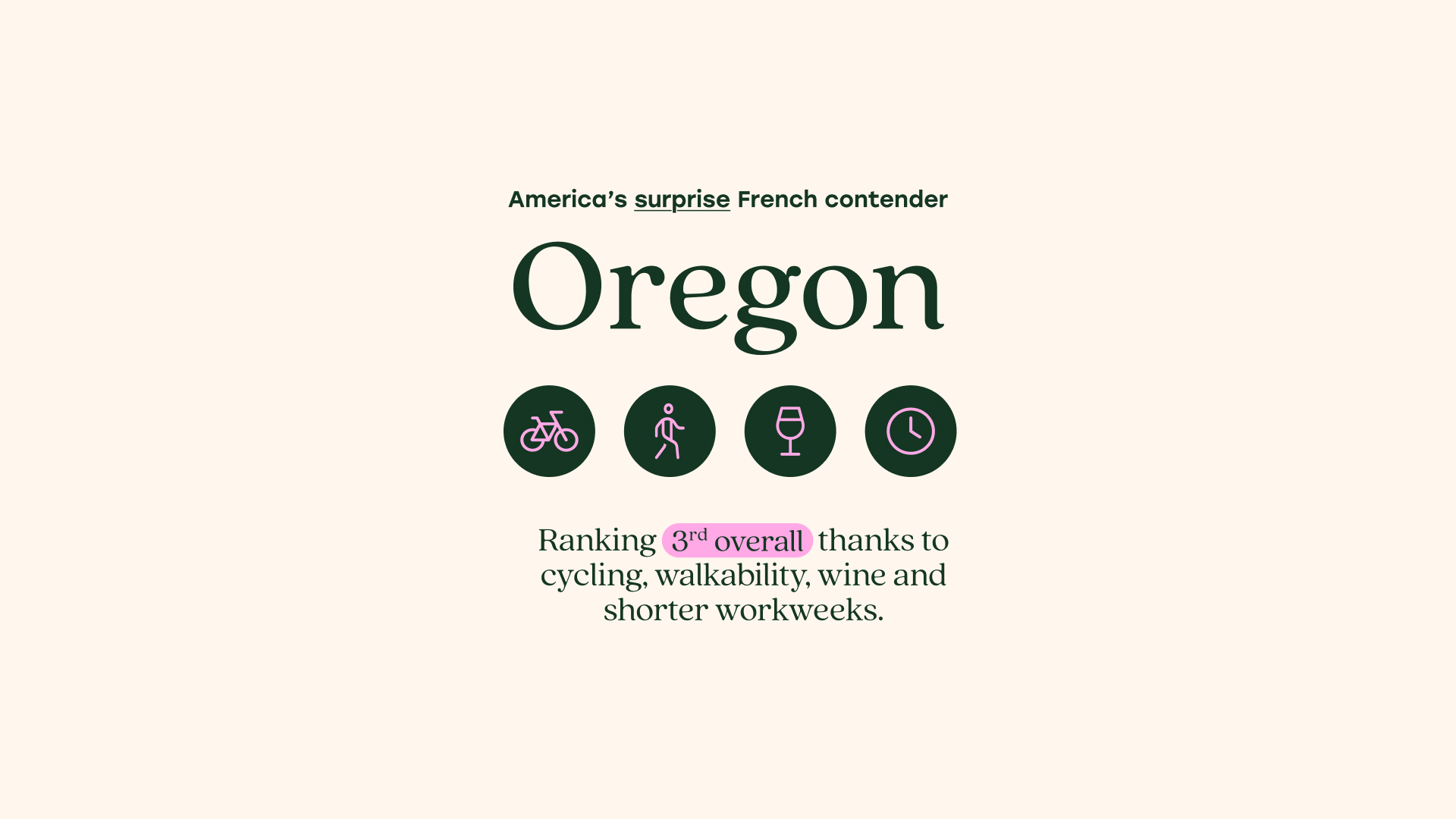
It ranks #3 nationally for shortest working hours, at 37.8 hours per week.
It comes in at #3 for cycling friendliness, as ranked by the League of American Bicyclists. Cycling was included in the index because France is famously bike-friendly, both as an everyday mode of transport and as a sporting culture. It is, after all, home to the Tour de France, the world's most watched annual cycling race.
It also places joint #3 for walkability, according to the EPA National Walkability Index, and sits in the top five for wine production. No single category makes it French. But, more so, the combination does.
Oregon’s “Frenchness” is not inherited or declared. It shows up in the way people live.
Also très français
Massachusetts and New York both crack the top 5, scoring on heritage, language, cycling and walkability. Connecticut and Rhode Island round out the New England cluster.
Washington earns its place through wine production and cycling.
Then there’s Illinois. It reached joint ninth because of a single policy decision: its 2024 mandated paid time-off law. Colorado completes the top 10 at joint ninth, scoring on cycling, French heritage and walkability.
New Hampshire finishes tenth, its deep French and French-Canadian roots placing it firmly in the New England cluster.
Louisiana, home to some of the deepest French roots in America, finished 38th, its heritage outweighed by lifestyle and metrics that tell a different story.
A winner in every category
One of the things we wanted this index to show was that “French” does not always look the way people expect. Some states rank highly because of heritage or language. Others stand out for qualities that feel French in a less obvious way.
.jpg)
Hawaii, as we mentioned earlier, leads the country in artisan bakery density. The data looks specifically at bake-on-premises bakeries – places where bread, pastries and other baked goods are made fresh on site – giving Hawaii more of these bakeries per person than any other state.
Wyoming has more bookshops per person than anywhere else in the US. Utah, the shortest working week.
California co-leads the country in walkability alongside Rhose Island and leads in wine production, accounting for 82% of all American wine in 2023. France, home to the Pinot Noir, the Chardonnay and the Sauvignon Blanc, is the world’s second largest wine producer – and yes, they take it rather seriously.
None of these states set out to be French. That is precisely what makes the finding interesting. French values, like the short week, the market, the walk, and the bookshop, are alive and well in America.
Methodology
America’s Most French State Index ranks all 50 US states on how closely their lifestyle, culture and values align with those of France.
Each state was scored across 11 government or credible third-party sources, grouped into 4 equally weighted themes: French Cultural Connection, Work-Life Balance, Food & Artisan Culture, and Lifestyle & Place Feel. Each theme contributes 25 points to a maximum total score of 100.
Points are awarded using a linear scaling formula based on each state’s rank within each criterion. This ensures every state receives a proportional score. First place always receives full points, last place receives zero, and all positions in between are scaled accordingly. Where states share the same score, they receive equal points.
.jpe)
Full methodology notes and data sources are available on request.